If you’ve searched for a free school management system in Kenya, you’re probably trying to digitise your school without adding another major expense to the budget.
That’s understandable, especially for small and growing schools.
But there is an important question to ask before choosing any platform:
What does “free” actually mean?
A school management system may be advertised as free while charging separately for hosting, SMS, technical support, payment integration, updates or advanced features.
Other platforms provide a genuinely free trial so a school can test the complete system before deciding whether to pay for it.
This guide explains what Kenyan schools should look for when considering free school management software, the possible costs to watch for, and how to determine whether a system will still serve the school as it grows.
Quick answer: Yes, Kenyan schools can use a free school management system through open-source software, free plans or free trials, but “free” rarely means zero cost. Check hosting, technical support, SMS, M-Pesa integration, updates and data migration before choosing. Kisoma offers a free one-term trial, then costs KES 10 per student per month.
Is There a Free School Management System in Kenya?
Yes. Kenyan schools can find free school management systems, open-source software, limited free plans and free trials. However, “free” does not always mean that using the system will have zero cost.
A school may encounter several types of free offers:
| Type | What it usually means |
|---|---|
| Free trial | Use the software for a limited period before paying |
| Free plan | Continue using selected features without a subscription |
| Open-source software | Software can be installed and modified, but hosting and maintenance may still cost money |
| Freemium | Basic functionality is free while advanced features are paid |
| Free implementation period | Full service may be temporarily free before normal pricing begins |
Understanding which model is being offered is more useful than simply looking for the word “free.”
Why Kenyan Schools Search for Free School Management Software
Moving from manual records to a digital system can feel expensive.
A school may already be paying for internet connectivity, computers, SMS communication, accounting services and other operational requirements.
Smaller schools in particular may not want to commit thousands of shillings to software before knowing whether teachers and administrators will actually use it.
A free trial or affordable entry plan can therefore allow a school to test digital management with less financial risk.
But price shouldn’t be the only consideration.
The system still needs to solve the school’s actual problems.
What Should a Free School Management System Include?
Before choosing a free school management system in Kenya, look beyond the dashboard screenshots.
A useful platform should support the core processes your school performs every day.
1. Student Management
Student information is at the centre of most school operations.
A school management system should make it easy to maintain organised learner records, including relevant admission, class and guardian information.
As the school grows, administrators should be able to find student information without searching through multiple registers and spreadsheets.
2. CBE/CBC Academic Management
For Kenyan schools, curriculum support matters.
The system should accommodate the academic structure used by the school, including relevant grades, learning areas, terms, assessments and reporting processes.
This is particularly important under Competency Based Education (CBE).
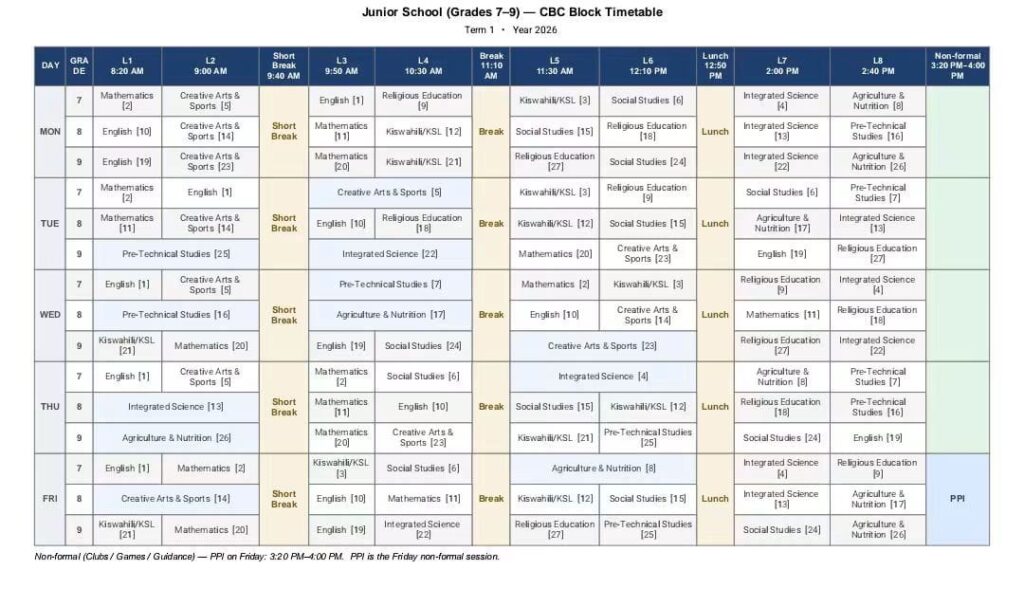
For example, Ministry of Education timetable guidelines specify different lesson requirements for different levels. Grades 1–3 have 31 weekly lessons, Grades 4–6 have 35, while Grades 7–9 have 41.
That illustrates why software intended for Kenyan schools needs to understand the local academic structure rather than treating every school system identically.
Related guides: CBE/CBC Timetable Guidelines in Kenya: Complete Guide for Pre-Primary to Grade 9 and Pre-Primary CBE Timetable in Kenya
3. School Fees Management
Managing fees manually becomes increasingly difficult as enrolment grows.
A useful school management system should help administrators maintain payment records, student balances and fee information in an organised way.
When evaluating a free system, check whether fees management is actually included in the free package.
Sometimes the student-information module is free while financial features require an upgrade.
4. M-Pesa and Local Payment Support
This is particularly important in Kenya.
If parents pay school fees through mobile money, administrators shouldn’t have to spend unnecessary time manually matching every transaction to a learner.
When evaluating a school management platform, ask whether it supports the payment methods your school uses.
Also ask whether payment integration is included in the advertised price or charged separately.
Kisoma supports local payment workflows including M-Pesa and Airtel Money, making the platform more relevant to Kenyan school operations.
5. Assessments and Academic Reports
Teachers need a practical way to record learner performance.
A school management platform should help organise assessments, grading, academic information and reports.
For schools implementing CBE/CBC, verify that the assessment process fits the curriculum structure your school actually uses.
A generic “marks” module isn’t necessarily the same thing as proper curriculum support.
6. Attendance Management
Paper attendance registers work, but retrieving and analysing information later can become cumbersome.
Digital attendance can make records easier to maintain and access.
Before choosing a free platform, check whether attendance is included or reserved for a paid plan.
7. Timetable Management
Timetabling is another area where school software can reduce administrative work.
Schools have to coordinate classes, learning areas, teachers, streams and lesson periods while preventing clashes.
CBE timetabling also has specific requirements.
For example, the Ministry guidelines state that learning areas involving similar skills, knowledge or concepts should not immediately follow each other, helping reduce monotony for learners.
The right software should help administrators organise these requirements rather than making timetable preparation more complicated.
8. Parent and Guardian Information
A school shouldn’t have to maintain completely separate records every time it needs to contact a learner’s guardian.
Student and guardian information should be properly connected.
Depending on the platform, schools may also get parent portals, notifications or other communication tools.
Again, verify which of these are actually included in the free offering.
Is a Free School Management System Really Free?
This is where schools need to pay attention.
Free software and zero-cost school management are not necessarily the same thing.
A platform may have no licence fee but still require money to operate.
Here are some costs worth checking.
Hosting
If the system is open source or self-hosted, somebody still has to provide the server where it runs.
Domain and SSL
A web-based installation may require a domain, configuration and security certificates.
Technical support
Who fixes the system when something stops working?
Free software may rely on community support rather than providing direct assistance to your school.
Installation and configuration
A free download doesn’t necessarily mean free implementation.
Someone may need to configure the server, database, school structure, users and other settings.
Updates and maintenance
School software needs to remain maintained.
Ask who is responsible for applying updates, fixing bugs and maintaining compatibility.
SMS charges
Even when communication features are included, individual SMS messages may have separate costs.
Payment transaction costs
Payment gateways and mobile-money services may have charges that are separate from the school-management subscription.
Training
Teachers and administrators may need onboarding before the system becomes useful.
Data migration
Moving existing student, academic and financial records into a new platform can require additional work.
So instead of asking only:
“Is this school management system free?”
ask:
“What is the total cost of using this system in our school?”
That’s a much better comparison.
Free vs Paid School Management System
Neither option is automatically right for every school.
| Free / Open-Source | Paid / Managed System |
|---|---|
| Lower initial software cost | Predictable subscription |
| May require self-hosting | Hosting may be managed |
| Technical knowledge may be required | Provider normally manages technical operations |
| Community support may be available | Direct support may be available |
| School may manage updates | Updates may be handled by provider |
| Good for technically capable organisations | Easier for schools without dedicated IT teams |
A school with an experienced IT administrator may be perfectly comfortable running an open-source platform.
Another school may prefer paying a modest subscription so teachers can focus on education while the provider handles the technology.
The right choice depends on the school’s resources.
For a full buyer’s checklist, see our guide on how to choose the best school management system in Kenya.
What About Free School Management System Downloads?
Another common search is:
“free school management system download.”
Be careful here.
Downloading unknown school-management software simply because it is free can introduce security and maintenance problems.
Remember that a school system may contain sensitive information about learners, parents, staff and finances.
Before installing downloadable software, determine:
- Who developed it?
- Is it still maintained?
- When was it last updated?
- Are security updates available?
- Is there documentation?
- Who will maintain the server?
- Can school data be backed up?
- Can the data be exported?
- What happens when the software fails?
For a school, data security and continuity are more important than saving a small software fee.
Free Excel School Management System vs Dedicated Software
Some schools start with Microsoft Excel or similar spreadsheets.
And that’s perfectly reasonable at a small scale.
A spreadsheet can handle basic lists, simple fee records and other administrative information.
The challenge appears when the school grows.
You may end up with:
Students_Final.xlsx
then:
Students_Final_Updated.xlsx
and eventually the legendary:
Students_Final_Updated_FINAL2.xlsx 😄
More seriously, separate spreadsheets can create duplicate records, inconsistent information and difficulty controlling who can access or change particular data.
Dedicated school management software becomes useful when different processes need to work from the same student and school records.
Should a Small School Pay for School Management Software?
Not necessarily immediately.
A small school should first determine whether the software will save enough time or solve enough problems to justify its cost.
That’s why trials are valuable.
Instead of purchasing a platform based solely on a sales demonstration, the school can actually use it.
Ask administrators and teachers:
Does this make our work easier?
Can staff understand it?
Does it solve the problems we currently have?
Can we afford it after the trial?
If the answers are yes, continuing with the platform becomes a much easier decision.
Kisoma: Try a School Management System Free for One Term
This is the approach we’ve taken with Kisoma.
Schools can start with a free one-term trial.
Rather than restricting a school to a few minutes of demonstration, the trial gives the institution an opportunity to see how digital school management fits into its actual operations.
After the trial, Kisoma uses simple student-based pricing:
KES 10 per student per month
or
KES 30 per student per term
That means a smaller school doesn’t have to pay the same subscription as an institution with thousands of learners.
For example:
| Students | Per Month | Per Term |
|---|---|---|
| 100 | KES 1,000 | KES 3,000 |
| 200 | KES 2,000 | KES 6,000 |
| 300 | KES 3,000 | KES 9,000 |
| 500 | KES 5,000 | KES 15,000 |
| 1,000 | KES 10,000 | KES 30,000 |
This gives schools a chance to try first, then decide.
What Does Kisoma Help Schools Manage?
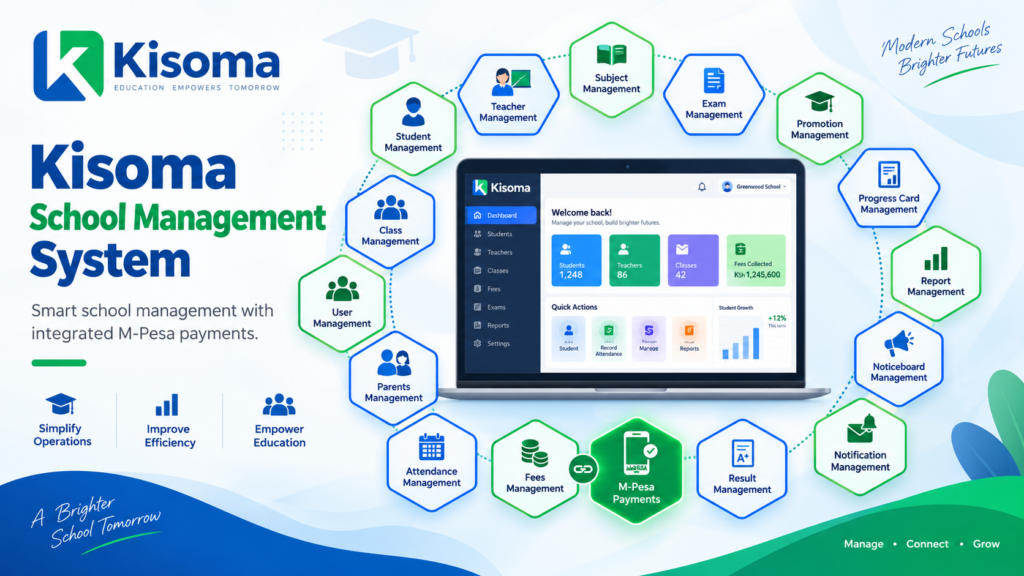
Kisoma is built for school management in Kenya, with functionality covering important academic and administrative processes.
These include student management, academic structures, assessments and grading, fees, payment workflows, teachers, guardians, reporting and other everyday school-management activities.
Kisoma also supports local payment workflows including M-Pesa and Airtel Money.
And because Kenyan schools operate within CBE/CBC requirements, Kisoma’s academic direction is designed around the local school environment rather than simply changing the labels on a generic foreign system.
How to Choose a Free School Management System in Kenya
Before signing up, downloading or installing anything, use this simple test:
Curriculum: Does it support your school’s CBE/CBC academic structure?
Students: Can you properly manage learner and guardian records?
Academics: Can teachers manage assessments and reports?
Fees: Can the school manage payments and balances?
Payments: Does it support the payment methods parents actually use?
Security: How is school data protected?
Backups: What happens if something goes wrong?
Support: Is there someone to contact when you need assistance?
Ease of use: Can teachers and administrators actually use it?
Growth: Will the platform still work when enrolment increases?
Cost: What will you actually pay after all additional services are included?
If a free system passes those tests, then it may be worth considering.
If it doesn’t, the fact that it costs zero shillings doesn’t make it a bargain.
Frequently Asked Questions About Free School Management Systems in Kenya
Is there a free school management system in Kenya?
Yes. Schools can find open-source school management software, free plans and free trials. However, schools should check whether hosting, technical support, SMS, payment integrations, maintenance or advanced modules involve additional costs.
What is the best free school management system in Kenya?
There isn’t one platform that will be best for every school. The appropriate choice depends on the school’s curriculum, enrolment, budget, technical resources and required features. Evaluate CBE/CBC support, fees, assessments, student records, security, support and total operating cost before choosing.
Does Kisoma offer a free school management system?
Kisoma offers Kenyan schools a free one-term trial so they can evaluate the platform before moving to paid use.
How much does Kisoma cost after the free trial?
Kisoma costs KES 10 per student per month or KES 30 per student per term after the trial.
Can I download a free school management system?
Open-source and downloadable school management systems exist, but schools should verify security, maintenance, backups, technical support and hosting requirements before installing one.
Can I manage my school using Excel for free?
Spreadsheets can work for basic school records, particularly in small institutions. As the school grows, dedicated software can make it easier to centralise student, academic, fee and other administrative information.
Does school management software support CBC/CBE?
Some platforms do, but curriculum support varies. Kenyan schools should verify the actual grades, learning areas, assessments, reporting and academic structure supported by a system rather than relying solely on a “CBC supported” claim.
Can a school management system work with M-Pesa?
Some Kenyan school management systems support M-Pesa or related mobile-money workflows. Schools should confirm how payments are recorded and reconciled and whether there are additional integration or transaction charges.
Is open-source school management software completely free?
The software licence may be free, but operating it can still involve hosting, configuration, maintenance, backups, security, technical support and other costs.
Try Kisoma Free for One Term
You don’t have to decide whether a school management system is right for your school from a brochure.
Try Kisoma in your school for one term.
Manage your school digitally, let your team experience the platform and then decide whether it works for you.
Free one-term trial.
KES 10 per student/month or KES 30 per student/term thereafter.
Kisoma — Elimu Digitali.