Choosing the best school management system in Kenya can be difficult.
Quick answer: What is the best school management system in Kenya?
The best school management system for a Kenyan school depends on its curriculum, enrolment, budget and operational requirements. Schools should look for CBE/CBC support, student management, fees, assessments, reporting, local payment options such as M-Pesa, parent communication, simple pricing and reliable support. Kisoma is a Kenya-focused school management platform offering a free one-term trial and pricing from KES 10 per student per month.
At the same time, cost matters.
Some schools search for a free school management system in Kenya, while others want an affordable system they can test before committing to a subscription.
So, what actually makes a good school management system for a Kenyan school?
In this guide, we look at the key features schools should consider, common pricing models, free options and how Kisoma School Management System approaches digital school management for Kenya.
What Is a School Management System?
A school management system is software used to organise and manage a school’s academic and administrative processes from one central platform.
Instead of keeping information across paper files, spreadsheets and separate applications, a school can use one system to manage its day-to-day operations.
Modern school management software commonly covers areas such as:
- Student information
- Admissions
- Academic records
- Fees
- Attendance
- Assessments and results
- Timetables
- Teachers
- Parent or guardian information
- Communication
- Reports
Student management, fees, examinations, attendance and parent communication are the core functions most Kenyan schools expect from these platforms.
What Is the Best School Management System in Kenya?
There isn’t one answer that applies to every school.
The best school management system in Kenya is one that matches the school’s curriculum, size, budget and administrative requirements while remaining simple enough for staff to actually use.
For a Kenyan school, particularly one implementing Competency Based Education, important considerations include:
CBE/CBC support, student management, school fees, assessments, reporting, local payment options, communication, usability, support and affordable pricing.
A system with dozens of modules isn’t necessarily better if teachers and administrators find it difficult to use.
The better question therefore becomes:
Which school management system gives our school the features we actually need at a price we can sustain?
1. CBE/CBC Support Should Be a Priority
One of the biggest considerations for Kenyan schools is curriculum support.
A school management system designed for Kenya should be able to accommodate the structure schools use under Competency Based Education (CBE)/Competency Based Curriculum (CBC).
That includes managing relevant:
- Grades
- Learning areas
- Academic terms
- Assessments
- Learner performance
- Academic reports
Because CBE is now Kenya’s national curriculum framework, CBE/CBC support has become one of the most important buying considerations for Kenyan schools.
For schools, curriculum support should therefore be evaluated before choosing a system rather than treated as an optional extra.
2. Student Information Management
A good school management system should provide a central student record.
Administrators should be able to access important learner information without searching through different spreadsheets or physical files.
A central student database also makes other school processes easier because admissions, academics, fees and guardians can all reference the same learner record.
For growing schools, this becomes particularly important.
3. School Fees Management
For many Kenyan schools, fees and fee collection are the main reason to adopt a school management system.
That makes sense.
Fee administration is one of the most important operational responsibilities in many schools.
A good school management system should make it easier to:
- Record student fees
- Track payments
- View balances
- Maintain fee records
- Produce financial information
- Follow up outstanding balances
Fees and payment management should therefore be one of the core capabilities you evaluate when buying school software.
4. M-Pesa and Digital Payments
For Kenyan schools, payment integration is particularly relevant.
Schools increasingly want payments received digitally to connect with their school records instead of requiring administrators to manually compare mobile-money transactions with spreadsheets.
That is why M-Pesa integration is now a standard question when Kenyan schools compare school management systems.
For schools evaluating software, it is worth asking:
Does the system support the payment methods our parents actually use?
Kisoma is developed for the Kenyan market with support for local payment workflows, including M-Pesa and Airtel Money.
5. Exams, Assessments and Academic Reports
Academic information is another major part of school administration.
Teachers and administrators should be able to manage learner performance without rebuilding spreadsheets every term.
An effective system should help organise:
- Assessment records
- Marks or performance information
- Grading
- Learner progress
- Academic reports
For schools implementing CBE, this becomes especially important because the academic structure should reflect the curriculum used by the school.
6. School Timetable Management
Timetabling can quickly become complicated.
Administrators have to coordinate teachers, learning areas, grades, streams and available periods while avoiding conflicts.
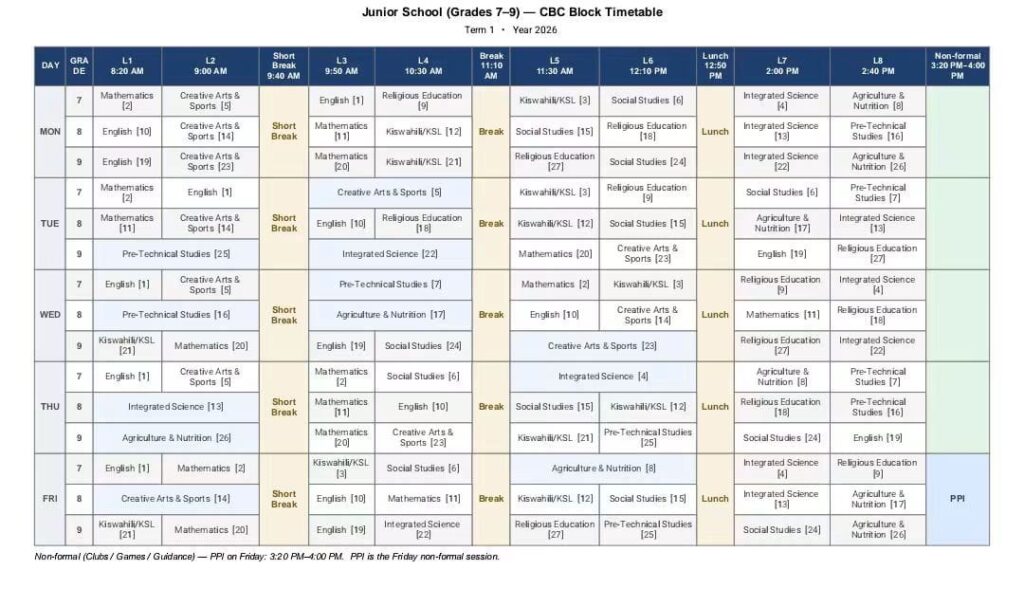
For CBE/CBC schools, timetable creation also has to consider lesson allocations and lesson duration at different levels.
We have covered those requirements separately in our CBE/CBC Timetable Guidelines for Kenyan Schools.
7. Parent and Guardian Communication
Parents increasingly expect timely information from their children’s schools.
A good school management platform should therefore make communication easier rather than forcing administrators to repeatedly transfer information between different systems.
Depending on a school’s requirements, communication may involve:
- School announcements
- Fee information
- Academic information
- Student updates
- SMS notifications
- Parent or guardian access
Parent communication should be one of the core capabilities you test before choosing a system.
8. Easy-to-Use Teacher and Administrator Portals
Having many features means little if staff cannot use them comfortably.
When choosing school software, ask teachers and administrators to test it.
Can a teacher find what they need?
Can an administrator locate a student quickly?
Can important tasks be completed without extensive technical knowledge?
The best school management software should reduce administrative work — not create another complicated job for teachers.
Is There a Free School Management System in Kenya?
Yes, there are school-management solutions marketed with free licences, free tiers or free trials.
But “free” can mean several different things.
A school may encounter:
- Fully open-source software
- Free versions with limited features
- Free trials
- Free initial periods
- Software with no licence charge but paid hosting or implementation
- Paid platforms offering free onboarding periods
For example, some products are open source or have a free core, while other commercial providers offer limited free trials. Our guide to a free school management system in Kenya explains the hidden costs to check.
That means schools shouldn’t ask only:
“Is it free?”
They should also ask:
“What will this system cost us once we actually start using it?”
What Should You Check Before Choosing a Free School Management System?
Free school software can be useful, particularly for smaller schools, but schools should check what is actually included.
Ask:
Is there a student limit?
Some free plans limit the number of learners that can be registered.
Are all modules available?
The free tier may exclude important features.
Is technical support included?
Software without adequate support can create problems when something goes wrong.
Are SMS messages included?
Communication charges may be separate.
Are payment integrations included?
M-Pesa or other payment services may require additional configuration or charges.
Is hosting included?
Some open-source school systems may be free to download but still require a server, maintenance, backups and technical administration.
Can your data be exported?
Your school should understand how its information can be retrieved if it later changes systems.
Free software can therefore be a good choice — but free should never be the only selection criterion.
Does Kisoma Offer a Free Option?
Schools interested in Kisoma can start with a free one-term trial.
The idea is simple:
A school should be able to experience the system in an actual school environment before deciding whether it works for them.
Rather than purchasing software based only on screenshots or a sales presentation, administrators can assess whether Kisoma fits their daily operations.
That makes the trial particularly useful for schools moving away from paper records or spreadsheets for the first time.
How Much Does a School Management System Cost in Kenya?
There is no single standard price.
Current providers use several pricing models, including:
- Monthly subscriptions
- Annual subscriptions
- Per-student pricing
- Per-school pricing
- Module-based pricing
- Setup or implementation fees
Prices in Kenya vary considerably, from small monthly packages to implementations costing tens of thousands of shillings or more.
Schools should therefore compare the total cost, not simply the headline subscription.
Check whether the quotation includes:
- Hosting
- Setup
- Data migration
- Training
- Support
- SMS
- Payment integration
- Updates
Kisoma School Management System Pricing
Kisoma uses simple student-based pricing:
KES 10 per student per month
or
KES 30 per student per term
This allows the cost to scale with school enrolment rather than requiring the same fixed subscription from every school.
For example:
| Number of Students | Approx. Monthly Cost |
|---|---|
| 100 | KES 1,000 |
| 200 | KES 2,000 |
| 300 | KES 3,000 |
| 500 | KES 5,000 |
| 1,000 | KES 10,000 |
Schools can also start with the free one-term trial before moving to paid use.
What Makes Kisoma Different?
The best school management system for a Kenyan school should be built with Kenyan schools in mind. Kisoma is designed specifically for this market.
Rather than adapting a generic international platform to Kenyan terminology later, Kisoma focuses on the academic and administrative structures used by local schools.
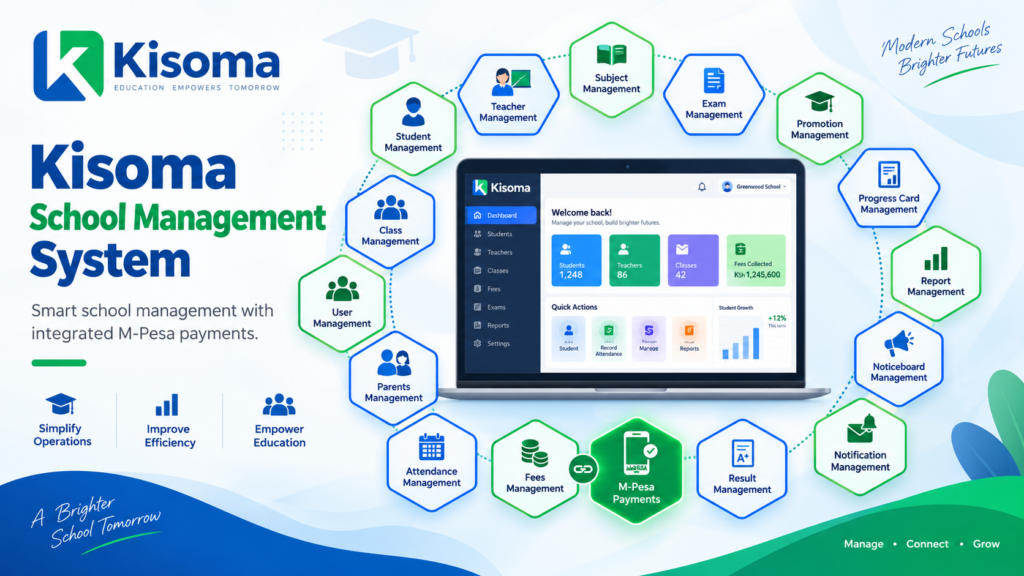
Kisoma brings school information into a digital environment where administrators, teachers and other authorised users can manage school processes more efficiently.
Its direction includes support for areas such as:
- Student management
- CBE/CBC academic structures
- Automated grading and academic analytics
- School fees and payments
- M-Pesa and Airtel Money
- Teacher workflows
- Parent and guardian information
- School communication
- Academic reporting
For schools looking for an affordable digital platform that can grow with their enrolment, Kisoma provides another option in Kenya’s expanding EdTech market.
Kisoma — Elimu Digitali.
School Management System vs School ERP: What’s the Difference?
Schools often see both terms when comparing software.
A school management system generally focuses specifically on school administration and academics.
A school ERP (Enterprise Resource Planning system) may extend further into areas such as finance, HR, payroll, procurement, inventory and other organisational operations.
In practice, the terms are often used interchangeably by school-software providers.
For a school, the name matters less than whether the platform solves the processes the institution actually needs.
Cloud-Based vs Installed School Management Software
Schools may also encounter cloud-based and locally installed systems.
A cloud-based school management system can generally be accessed through the internet without requiring the school to maintain its own application server onsite.
This can make deployment and updates easier, particularly for schools without dedicated IT personnel.
However, schools should still consider:
- Internet availability
- Data protection
- Backups
- Access control
- Technical support
- Reliability
The right model depends on the needs and resources of the institution.
How to Choose the Best School Management System in Kenya
Before purchasing school software, create a simple checklist.
1. Identify the school’s biggest problems
Don’t start with the software.
Start with the problem.
Are you struggling with fees?
Academic reports?
Student records?
Communication?
Assessments?
Timetables?
Knowing the problem makes comparing systems much easier.
2. Request a demonstration
Don’t make a decision based entirely on a website.
See the actual platform.
3. Let real users test it
Include teachers, administrators and other staff who will use the system regularly.
4. Ask about the full cost
Confirm implementation, support, SMS, training and other charges before committing.
5. Check Kenyan curriculum support
Make sure the platform fits your school’s academic structure.
6. Check payment options
For Kenyan schools, local payment support can significantly simplify fee management.
7. Start with a trial where possible
Testing software with actual school workflows is one of the best ways to determine whether it is suitable.
Why Kenyan Schools Are Moving to Digital School Management
The goal of digitisation isn’t simply to remove paper.
It’s to make information easier to manage.
A well-implemented school management system can help administrators reduce repetitive work, maintain organised records and access information faster.
Instead of maintaining different versions of student information across notebooks, spreadsheets and separate systems, schools can gradually bring their operations into one central platform.
And as schools grow, having structured digital records becomes increasingly valuable.
Frequently Asked Questions
What is the best school management system in Kenya?
The best school management system depends on a school’s size, budget, curriculum and required features. Kenyan schools should prioritise CBE/CBC support, student records, fees, assessments, reporting, local payments, communication, ease of use and reliable support.
Is there a free school management system in Kenya?
Yes. Some systems offer free or open-source licences, while others provide free tiers or trial periods. Schools should check whether hosting, support, SMS, implementation and payment integrations carry additional costs.
Does Kisoma have a free version?
Kisoma offers schools a free one-term trial, allowing the institution to test the system before moving to paid use.
How much does Kisoma cost?
Kisoma is priced at KES 10 per student per month, equivalent to KES 30 per student per term.
What features should a school management system have?
Important features include student management, fees, academic records, assessments, attendance, timetables, communication, reporting and appropriate curriculum support.
What is a school ERP?
A school ERP is a centralised system for managing various school processes. Depending on the platform, it can combine academics and student management with functions such as finance, HR, payroll, inventory and administration.
Should a Kenyan school management system support CBE/CBC?
Schools implementing Competency Based Education should select software capable of supporting their curriculum structure, academic records and assessment requirements.
Can a school management system integrate with M-Pesa?
Some Kenyan school management systems provide M-Pesa integration or support mobile-money payment workflows. Schools should verify precisely how payments are received, identified and reconciled before choosing a provider.
Is cloud school management software suitable for small schools?
It can be. Cloud systems can reduce the need to maintain local application infrastructure, but schools should still evaluate internet connectivity, security, support, backups and overall cost.
Ready to Digitise Your School?
Managing a school shouldn’t require dozens of spreadsheets, registers and disconnected processes.
Kisoma helps Kenyan schools move their academic and administrative processes into one digital platform, making it a strong option for schools that want a Kenya-focused system with local support.
Start with a free one-term trial and see how Kisoma fits your school.
See Kisoma pricing and start your free one-term trial.
Kisoma — Elimu Digitali.