
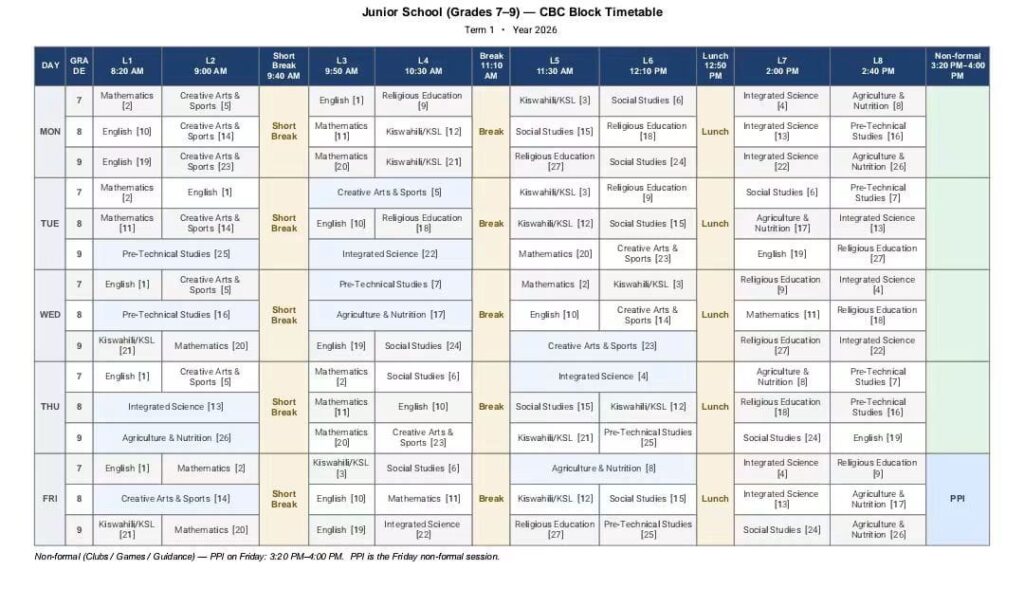
Preparing a Pre-Primary CBE timetable in Kenya requires schools to follow specific requirements on lesson allocation, lesson duration, reporting time, health breaks and the arrangement of learning activities.
According to the Ministry of Education’s Guidelines for Timetabling and Curriculum Based Establishment in Competency Based Education, Pre-Primary learners should have 25 lessons per week, with each lesson lasting 30 minutes.
This Kisoma guide breaks down the requirements in a simple format that Pre-Primary teachers, school administrators and timetabling committees can use when preparing their school timetable.
Quick answer: In Kenya, Pre-Primary (PP1 and PP2) learners have 5 lessons per day and 25 lessons per week, each lasting 30 minutes. Learners report at 8:30 am, formal lessons run from 9:00 am to 12:00 noon with two health breaks (10 and 20 minutes), and double lessons are not allowed.
Source: Ministry of Education, Guidelines for Timetabling and Curriculum Based Establishment in Competency Based Education. Last reviewed: October 2026.
How Many Lessons Should Pre-Primary Have in Kenya?
Pre-Primary should have five lessons per day, giving a total of 25 lessons per week, inclusive of PPI/religious programmes. Each lesson should last 30 minutes.
Here is the quick breakdown:
| Requirement | Pre-Primary |
|---|---|
| Lessons per day | 5 |
| Lessons per week | 25 |
| Duration per lesson | 30 minutes |
| Reporting time | 8:30 am |
| Lessons begin | 9:00 am |
| Lessons end | 12:00 pm |
| Double lessons | Not allowed |
| Health breaks | Two |
This makes Pre-Primary different from the longer lesson schedules used in Primary and Junior School.
For Grade 1 to Grade 9 lesson allocations, see our complete CBE timetable guidelines for Kenya.
Pre-Primary Reporting and Lesson Times
The Ministry guidelines provide a clear daily schedule for Pre-Primary schools.
Learners should report at 8:30 am.
The period between 8:30 am and 9:00 am should be used for health checks and roll call.
Formal lessons then begin at 9:00 am and end at 12:00 noon.
What happens when a learner arrives before 8:30 am?
The guidelines state that learners arriving early should be guided by the teacher through free-choice activities.
Pre-Primary daily timetable at a glance
Before 8:30 am: Free-choice activities for early arrivals
8:30–9:00 am: Health check and roll call
9:00 am: Lessons begin
12:00 pm: Formal lessons end
This daily routine should be considered before learning areas are assigned to individual periods.
Pre-Primary CBE Lesson Allocation in Kenya
The Ministry guideline provides the number of lessons that should be allocated to each learning area during the week.
| Learning Area | Lessons Per Week |
|---|---|
| Language Activities | 5 |
| Mathematical Activities | 5 |
| Creative Activities | 6 |
| Environmental Activities | 5 |
| Religious Activities | 3 |
| PPI / Religious Programmes | 1 |
| Total | 25 |
Creative Activities receive the largest allocation at six lessons per week, while Language, Mathematical and Environmental Activities each receive five.
Religious Activities receive three lessons, with one additional lesson allocated to PPI/religious programmes.
Are Double Lessons Allowed in Pre-Primary?
No.
The Ministry guidelines explicitly state that there should be no double lesson on the Pre-Primary timetable.
This means schools shouldn’t combine two consecutive lesson periods into a single extended lesson.
When creating the timetable, the committee should instead distribute learning activities appropriately throughout the week.
How Should Learning Areas Be Arranged?
Simply achieving 25 lessons isn’t enough.
The order of learning areas also matters.
The Ministry states that learning areas involving similar skills, knowledge or concepts should not follow one another.
The broader timetable guidance explains why: separating similar learning experiences helps maintain learner interest and reduces monotony in the acquisition of skills, concepts and knowledge.
For a timetabling committee, that means checking not only:
“Have we allocated all five Language Activities lessons?”
but also:
“What activities have we placed immediately before and after them?”
That makes timetable quality different from simply filling empty periods.
When Should Creative Activities Be Scheduled?
Creative Activities should be scheduled before a break.
The Ministry’s general timetable notes explain that Creative Activities and other physical or movement-oriented learning areas are placed before breaks to allow learners adequate time to prepare for the next lesson.
This is another rule a school should account for when preparing the weekly timetable.
Health Breaks in the Pre-Primary Timetable
Pre-Primary learners should have two health breaks.
According to the guidelines:
- The first health break is 10 minutes
- The second health break is 20 minutes
These breaks form part of the daily timetable structure rather than being treated as additional lesson periods.
Sample Pre-Primary CBE Timetable Structure
The Ministry document includes a sample Pre-Primary timetable in Appendix 1.
Its daily structure follows approximately:
| Time | Activity |
|---|---|
| Before 8:30 am | Free-choice activities |
| 8:30–9:00 am | Health check and roll call |
| 9:00–9:30 am | Lesson 1 |
| 9:30–10:00 am | Lesson 2 |
| 10:00–10:10 am | Health break |
| 10:10–10:40 am | Lesson 3 |
| 10:40–11:00 am | Health break |
| 11:00–11:30 am | Lesson 4 |
| 11:30–12:00 pm | Lesson 5 |
| 12:00–1:00 pm | Lunch break |
| After 1:00 pm | Rest/quiet activities/home |
The sample timetable then distributes Language, Mathematical, Creative, Environmental, Religious Activities and PPI throughout the school week.
Importantly, schools should understand this as the sample structure supplied in the Ministry guideline, while still ensuring their timetable complies with the stated lesson allocations and timetabling rules.
Example: How the 25 Weekly Lessons Fit Together
A school’s weekly allocation needs to add up correctly.
The Ministry’s prescribed allocation is:
Language Activities: 5
Mathematical Activities: 5
Creative Activities: 6
Environmental Activities: 5
Religious Activities: 3
PPI/Religious Programmes: 1
Total:
5 + 5 + 6 + 5 + 3 + 1 = 25 lessons
This simple check is important when reviewing a timetable before approval.
If a learning area has too many periods, another may end up below its required weekly allocation.
Who Should Prepare the Pre-Primary Timetable?
Timetabling isn’t supposed to be handled by one teacher working alone.
According to the Ministry guidelines, schools should establish a timetabling committee.
The committee should include:
- Deputy Head of the institution as Chairperson
- Senior teacher
- Teacher representatives from Pre-Primary, Primary and Junior School
- Heads of subjects/learning areas
- Heads of departments
The committee should hold planning meetings at the beginning of every term to develop or review the timetable.
Once prepared, the timetable should be submitted to the Head of Institution for approval.
The approved timetable should then be displayed in administrative offices and on notice boards, while teachers extract their respective timetables for curriculum implementation.
Pre-Primary Timetable Checklist for Schools
Before approving a Pre-Primary timetable, a school can check the following:
25 lessons per week? ✓
Five lessons per day? ✓
30 minutes per lesson? ✓
Reporting at 8:30 am? ✓
Health check and roll call from 8:30–9:00 am? ✓
Lessons from 9:00 am–12:00 pm? ✓
Two health breaks included? ✓
No double lessons? ✓
Creative Activities positioned before a break? ✓
Correct weekly allocation for every learning area? ✓
Similar learning areas prevented from following each other? ✓
This checklist is also useful when a school reviews its timetable at the beginning of a new term.
Pre-Primary Timetabling and Kisoma
Preparing one timetable manually may look straightforward.
The complexity increases when a school has multiple levels, classes, streams and teachers.
The school then needs to coordinate academic structures while maintaining the correct learning-area allocations and avoiding scheduling problems.
Kisoma School Management System is built for Kenyan schools and provides a digital environment for managing school academic and administrative processes.
As part of digitising academic management, schools can organise their classes, learning areas, teachers and timetable information within a central system instead of relying entirely on disconnected records.
Kisoma offers Kenyan schools a free one-term trial, then costs KES 10 per student per month. See Kisoma pricing and start a free trial, or read what to look for in the best school management system in Kenya.
Kisoma — Elimu Digitali.
Frequently Asked Questions About Pre-Primary CBE Timetables
Do PP1 and PP2 follow the same timetable requirements?
Yes. The Ministry guideline sets one set of Pre-Primary requirements, 25 lessons per week of 30 minutes each, which applies to both PP1 and PP2 learners.
How many lessons should Pre-Primary have per day in Kenya?
Pre-Primary should have five lessons per day. These cumulatively make 25 lessons per week, including PPI/religious programmes.
How many lessons should Pre-Primary have per week?
Pre-Primary has 25 lessons per week.
How long is a Pre-Primary lesson in Kenya?
Each Pre-Primary lesson should last 30 minutes.
What time should Pre-Primary learners report to school?
The reporting time specified in the guideline is 8:30 am.
What time should Pre-Primary lessons start?
Formal lessons should begin at 9:00 am and end at 12:00 noon.
Are double lessons allowed in Pre-Primary?
No. The Ministry guidelines state that there should be no double lesson on the Pre-Primary timetable.
How many Creative Activities lessons are there in Pre-Primary?
There are six Creative Activities lessons per week, the highest allocation among the listed Pre-Primary learning areas.
How many health breaks should Pre-Primary learners have?
There should be two health breaks: the first lasts 10 minutes and the second lasts 20 minutes.
What are the Pre-Primary learning areas in the timetable?
The guideline lists Language Activities, Mathematical Activities, Creative Activities, Environmental Activities and Religious Activities, together with PPI/religious programmes.